Dental reputation management software without the FTC risk.
mConsent is dental reputation management software that measures your ratings across Google, Yelp, Healthgrades, and Facebook, surfaces new reviews as they land, and invites every patient who completes a visit to leave honest feedback. No review gating, no private filter forms, no 2024 FTC exposure. One dashboard.
Most practices don't lose patients to rivals. They lose them to silence.
A single unanswered review, a quiet drop in star rating, a five-star story posted on a channel nobody at the practice is watching. Each one is a small decision a prospective patient makes on your behalf — before they ever pick up the phone.
The uncomfortable part is that most of these decisions are made in plain sight. Patients read the response to the one-star review as carefully as they read the review itself. They notice when the practice's average slips below the other three in the search results. They check two or three review sources before scheduling a first appointment and Healthgrades and Yelp rarely get the same attention from a dental office as Google does.
The older fix for this is the one a lot of reputation vendors still quietly ship, asking happy patients for public reviews and routing unhappy ones to a private feedback form that stays off the internet. The rating climbs. The search ranking improves. Everyone wins, except the prospective patient who picked the practice because the numbers had been filtered in its favor.
The FTC closed that loop in October 2024. Gating reviews by expected sentiment is now illegal, whether your vendor calls it "sentiment routing," "satisfaction screening," or "private feedback forms". The penalty is up to $51,744 per violation, and liability lies with the practice that uses the workflow, not the software company that sold it.
Ask everyone. Filter no one. Respond to what actually shows up.
Some reputation tools use a practice called "review gating" — asking happy patients for public reviews and routing unhappy ones to private feedback forms.
The FTC's 2024 Rule on Consumer Reviews and Testimonials makes review gating illegal, with penalties of up to $51,744 per violation. The review-gating workflow — even if your vendor built it — exposes your practice to liability.
mConsent is designed differently. Every patient who completes a visit gets the same invitation to leave honest feedback on the public review platform of their choice. Good or bad, we ask, they decide. You respond. The result is a reputation that's earned — and defensible.
How other tools work
Patient is pre-screened with a satisfaction survey. Happy patients get routed to Google. Unhappy patients are diverted to a private feedback form never shown publicly. Your Google rating climbs — because only the good reviews were invited.
Prohibited by the FTC since October 2024.
How mConsent works
Every patient who completes a visit gets the same review invitation. They choose the platform. They write what they want. You get a notification, a dashboard, and the tools to respond promptly — which is what actually builds reputation over time.
FTC-compliant and defensible.
Review gating — even if your vendor built it — is the practice's liability, not the vendor's. The FTC penalty runs to whoever published the filtered ratings.
What our reputation management software does and what it isn't.
Reputation tools often blur the line between what's possible and what's compliant. Ours is explicit about scope. Here's what mConsent is and isn't designed to do for your review workflow.
Measure, ask, monitor, and respond — transparently.
- Send the same review invitation to every completed-visit patient with SMS consent on record.
- Surface new reviews across Google, Yelp, Healthgrades, and Facebook in one dashboard.
- Flag reviews that need a response and track response rate over time.
- Offer response templates for thanks, service recovery, and clinical clarifications — all editable before publishing.
- Publish responses to each channel from a single interface — with the patient's original review in view.
- Log every review invitation and response for internal audit under your BAA.
Anything that gates, hides, or fabricates reviews.
- Screen patients by expected sentiment or route unhappy patients to private feedback forms — prohibited by the FTC's 2024 rule.
- Suppress, hide, or delete negative reviews — only the review platform itself can remove a review, under its own policies.
- Write or fabricate reviews on behalf of patients, or post anything to a public platform as if it came from a patient.
- Text patients who haven't consented to SMS under the TCPA.
- Guarantee specific rating improvements, review counts, or new-patient numbers — those depend on your practice, team, and market.
A reputation platform that respects the law is a reputation platform that's defensible. When the FTC audits, when a competitor reports, when a patient complains — the only version of this product that holds up is the one that asks everyone, hides nothing, and logs it all.
Four steps. One workflow. Every completed visit.
One dashboard. Four repeatable workflows. Our reputation management software helps your team stay ahead of your reputation instead of reacting to it.
Measure
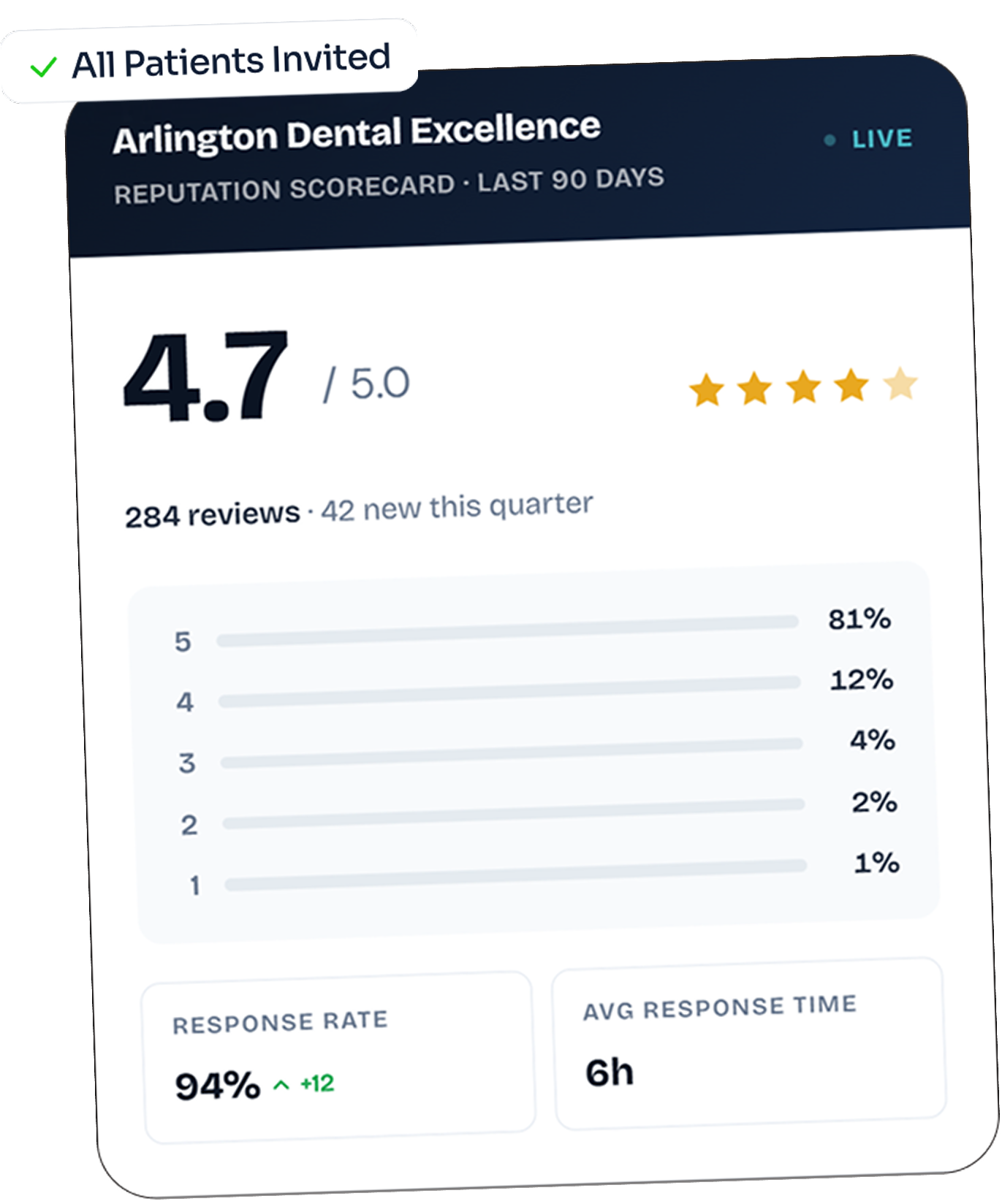
Connect your Google Business Profile, Yelp, Healthgrades, and Facebook listings. See your current rating, review count, and response rate on a single dashboard, with a simple benchmark against your local market.
Monitor
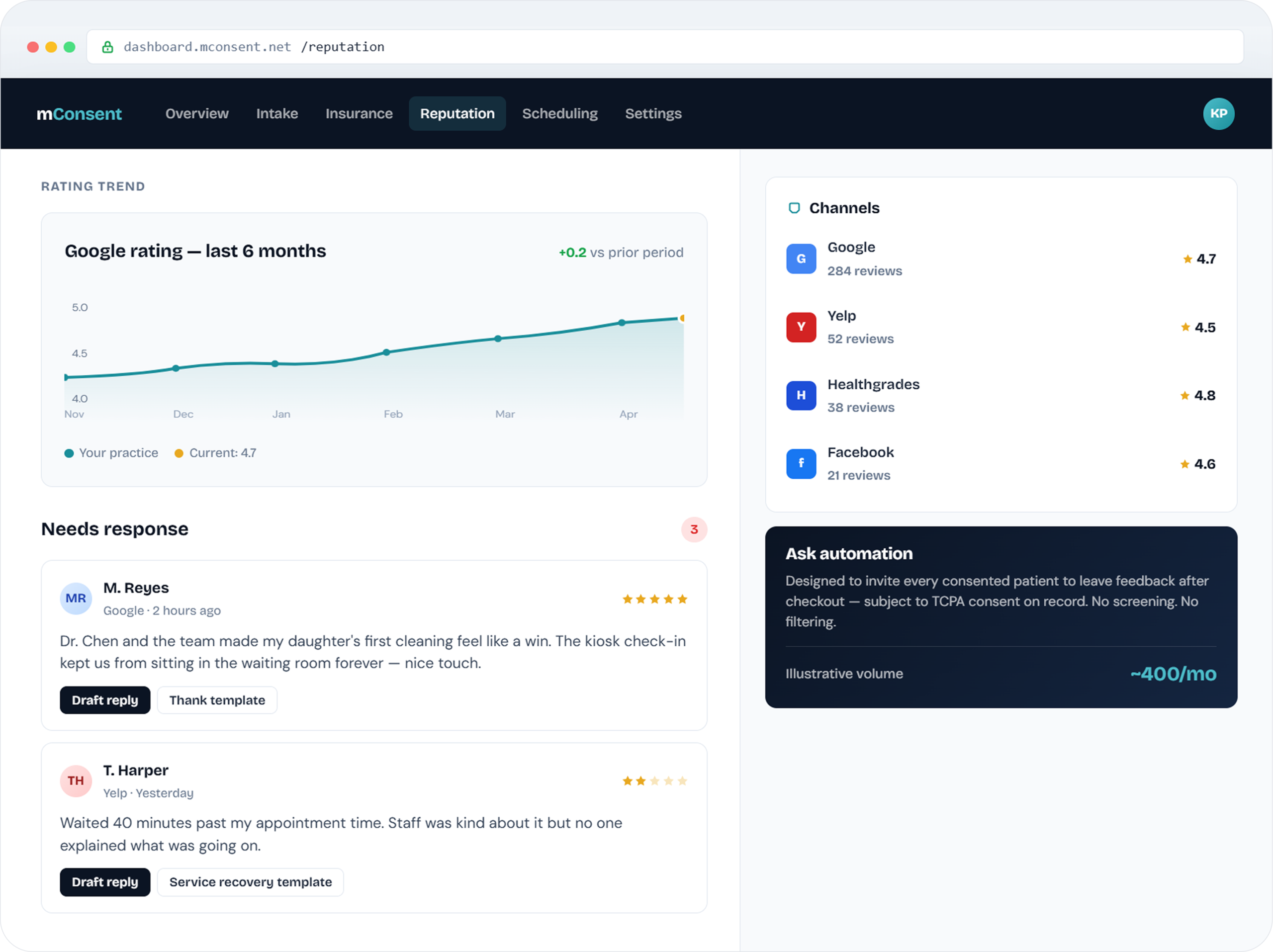
The software is designed to surface new reviews as they're posted on monitored channels and to highlight those that need a response. Response-rate trends are tracked for your team over time.
Ask
After a visit is completed, patients who have consented to SMS are invited to leave feedback, one tap, multiple platforms. No screening, no routing. Subject to TCPA consent on record.
Respond
Responses can be drafted directly in the dashboard using templates built for thanks, service recovery, and clinical clarifications. Publish to any monitored channel without logging into four different platforms
Two public reviews, left by actual mConsent customers.
Below are two real public reviews posted by verified mConsent customers. Outcomes at your practice will depend on your market, team, and starting point.
Partnering with mConsent has been such a great tool for our practice. In an age where everything is digital, patients come to expect the same for the process.
mConsent has been an amazing addition to our dental office. It's helped us go paperless for forms and automated appointment reminders and patient recalls.
Why pick dental-first reputation management software over a general-purpose platform?
Most reputation management software was built for restaurants, salons, or multi-industry SaaS, then retrofitted for healthcare. Here's how a dental-first approach differs on the criteria that matter most for a dental practice.
| What to look for | Typical general-purpose tool Built for multi-industry use |
The dental-first alternative |
|---|---|---|
| Industry focus | Built for multi-industry customers — restaurants, retail, services, healthcare | Purpose-built for dental practices since 2017 |
| Dental PMS integration | Dental PMS connections often need Zapier, webhooks, or CSV imports | Works directly with Dentrix, Eaglesoft, Open Dental, Dolphin, and other major PMS |
| HIPAA Business Associate Agreement | BAA availability and terms vary by vendor — verify before signing | BAA executed with every customer as standard |
| Healthgrades monitoring | Often not covered outside healthcare-specific platforms | Monitored alongside Google, Yelp, and Facebook |
| Onboarding model | Support models vary — many rely on self-serve setup and chat | White-glove onboarding with a dedicated account manager |
Every site new patients actually check.
Your reputation isn't just Google. Patients cross-reference multiple platforms and so does our software.
Google Business
Primary channel for most dental practices. Reviews, rating, response rate, and Google Business Profile signals.
Yelp
Still the second-most-checked channel for new patients in many US metros, especially 40+ demographic.
Healthgrades
Healthcare-specific, appears prominently in local healthcare searches. Often overlooked by general marketing.
Community recommendations and word-of-mouth. Reviews and recommendations feed into Facebook's local search.
The questions practice owners ask before they sign.
Including the hard ones about what's legal, what's not, and what happens after a bad review.
No. Every patient who consents to our SMS invitation receives the same review request, which links directly to the public review platforms they choose. We do not pre-screen patients, route unhappy patients to private feedback forms, or prevent any patient from leaving a public review.
Review gating — filtering which patients see public review links based on their satisfaction — is prohibited by the FTC's 2024 Rule on Consumer Reviews and Testimonials. It also makes your practice's rating undefensible if a consumer or competitor reports it. mConsent is designed to be compliant with that rule.
After a patient's visit is marked complete in your practice management system, patients who have previously consented to SMS receive a brief text with a single link. The link opens a page that offers the patient their choice of public review platforms — Google, Yelp, Healthgrades, or Facebook. They decide where to leave feedback. They write whatever they want. You get a dashboard notification when the review is posted.
Patients who have not consented to SMS are not texted. The invitation can also be offered via email where a patient prefers email contact and has consented accordingly.
The dashboard flags it as "Needs response" and alerts the team member who manages reviews. Response templates are available for common patterns — service recovery, clinical clarification, scheduling issues — and can be edited before publishing. A published response is visible on the review platform alongside the original review.
A thoughtful public response to a negative review is often more persuasive to future patients than the review itself. The goal is a defensible pattern of engagement, not a deleted review.
No. mConsent cannot edit, hide, or remove patient reviews. Only the review platform itself can remove a review, and only under that platform's policies (e.g., content that violates review guidelines, or clearly fraudulent content). If a review appears to violate a platform's terms, the dashboard includes guidance for reporting it to the platform.
mConsent is designed to work with all major dental practice management systems, including Dentrix, Eaglesoft, Open Dental, Dolphin, Dentrix Ascend, and others. Review invitations can be triggered by a visit-complete event in the PMS when integration is available, or via a simple manual workflow when it isn't.
Reputation monitoring setup is designed to take under an hour of your team's time. A dedicated onboarding account manager connects your Google Business Profile, Yelp, Healthgrades, and Facebook listings; configures the review invitation workflow; sets your response templates; and trains the team. Timing varies based on how many channels you have and PMS integration requirements.
mConsent operates as a Business Associate under HIPAA and executes a Business Associate Agreement (BAA) with each customer. Patient contact information used to send review invitations is protected under the BAA with administrative, physical, and technical safeguards designed to meet HIPAA requirements, including encryption in transit and at rest. Your onboarding team can walk through the BAA before contract execution.
Review invitations via SMS require prior consent from the patient under the Telephone Consumer Protection Act (TCPA). The intake forms included with mConsent capture this consent and log it with the patient record; patients who do not consent are not texted. Opt-out is supported via "STOP" reply on every SMS.
That depends on what you're using. If your current tool does review gating, replacing it reduces your FTC exposure. If it doesn't integrate with your PMS or doesn't cover multi-channel monitoring, mConsent is designed to consolidate both. Your onboarding team can walk through a migration plan during setup.
Pricing depends on the number of channels monitored, review invitation volume, and PMS integration requirements. The reputation scorecard at the bottom of this page is free and gives you a baseline before any sales conversation. For a priced proposal, book a demo — pricing is quoted per-practice after a short needs review. See pricing for general plan ranges.
See how your practice ranks against your local market in 2 minutes.
Enter your Google Business URL and email. We'll pull your current rating, review count, response rate, and compare you against peer practices in your area. You'll receive a one-page scorecard within 24 hours.
Reputation is one piece. The rest runs on the same dashboard.
Reputation is one piece. mConsent also handles paperless intake, insurance concierge, payments, AI voice, and patient communication — all from one dashboard.
Paperless Intake
Digital intake forms, ID/insurance capture, and PMS writeback — before the patient arrives.
ExploreInsurance Concierge
A white-glove team designed to recover revenue lost to insurance denials and verification gaps.
ExploremPayr
Text-to-pay, in-person terminals, and financing options designed to reduce checkout friction.
ExploreZaha AI
AI voice assistant designed to answer after-hours calls and route appointment requests to the front desk.
ExploreDisclosures & footnotes
Reputation outcomes vary by market, review history, and patient volume. mConsent does not support review gating; SMS invitations require prior TCPA consent and all implementation/pricing terms are governed by your Master Services Agreement.
Patient trust and response-rate correlation. Patient trust and response-rate correlation is a directional observation from industry reputation-management guidance. Individual practice results vary.
Local search visibility thresholds. Local search visibility thresholds are directional observations based on common patterns in local SEO research. Actual impact varies by market density, search intent, and platform ranking factors.
Multi-source consultation pattern. Multi-source consultation pattern is consistent with healthcare consumer research that patients typically consult more than one review source before selecting a new provider. Specific counts vary by study and demographic.
HIPAA, TCPA, and FTC reviews rule. mConsent operates as a Business Associate under HIPAA and executes a BAA with each customer. The review workflow is designed with administrative, physical, and technical safeguards appropriate to its role, including encryption in transit and at rest. Review invitations sent by SMS are subject to the TCPA and require prior express written consent captured at intake; patients who have not consented are not texted, and every SMS supports opt-out via “STOP” reply. Review gating — routing satisfied patients to public reviews while diverting unsatisfied patients to private feedback forms — is prohibited by the FTC’s 2024 Rule on Consumer Reviews and Testimonials (16 CFR Part 465, effective October 21, 2024; maximum civil penalty of $51,744 per violation) and is not a supported workflow on this platform. This liability runs to the practice that publishes the filtered ratings, not to mConsent as the underlying technology vendor.
Illustrative content and trademarks. Individual practice results vary; the scorecard, dashboard, review-invitation log, and channel ratings shown on this page are illustrative product representations, not actual customer data. “Arlington Dental Excellence” and the sample patient names are fictional for illustration. Illustrative figures shown in mockups (for example, sample invitation-log entries and the “400/mo” volume indicator) are representative examples only and do not reflect any specific practice’s actual invitation or response volume. The review-invitation workflow depicted is designed so that every patient with consent on file is invited to leave feedback after checkout; invitations are not screened or routed based on anticipated sentiment, and sent totals are designed to equal consented totals. mConsent cannot edit, delete, or remove patient reviews on third-party platforms. Google, Google Business Profile, Yelp, Healthgrades, Facebook, Dentrix, Eaglesoft, Open Dental, and Dolphin are trademarks of their respective owners, used with attribution, no affiliation implied. Specific pricing, implementation timelines, and feature availability are defined in your Master Services Agreement with mConsent.
Testimonials and customer reviews. The Google and Trustpilot reviews featured on this page are genuine, unedited reviews posted publicly by verified mConsent customers; they have not been solicited, incentivized, or altered for use on this page. Individual results are not typical and will vary by practice, market, and team. No testimonial guarantees similar outcomes at another practice.
Comparison table disclosure. The competitive comparison table on this page reflects general differences between dental-specific and general-purpose reputation-management platforms as of the publish date. Specific product capabilities change over time; verify current features directly with any vendor you are evaluating before making a purchasing decision.
Policy links. Security practices · FTC reviews rule · HIPAA · Privacy policy · Terms of service